

The critic’s dilemma
In an age of hot takes and hype cycles, what does it mean to be a fair, discerning critic?
Welcome back. If you’re new here, I’m Carly, a writer and editor at Figma, previously one of the co-founders of HAWRAF, a design studio. Last time, we talked about good taste in the age of AI. Today we’re taking on a topic that’s been stirring the pot across literary circles and tech reviews alike: the role of the critic.
In the high-stakes game of online discourse, it’s been a rough week for creators of all stripes. Lit-world enfant terrible Lauren Oyler, known for her scorched-earth book reviews, was on the receiving end of an epic takedown in the pages of Bookforum. Meanwhile in the tech realm, YouTuber Marques Brownlee’s negative critique of the new Humane AI wearable drew fire from startup loyalists on Twitter. Though arising from different scenes, both cases reveal something about this cultural moment, and the dance between maker and critic.
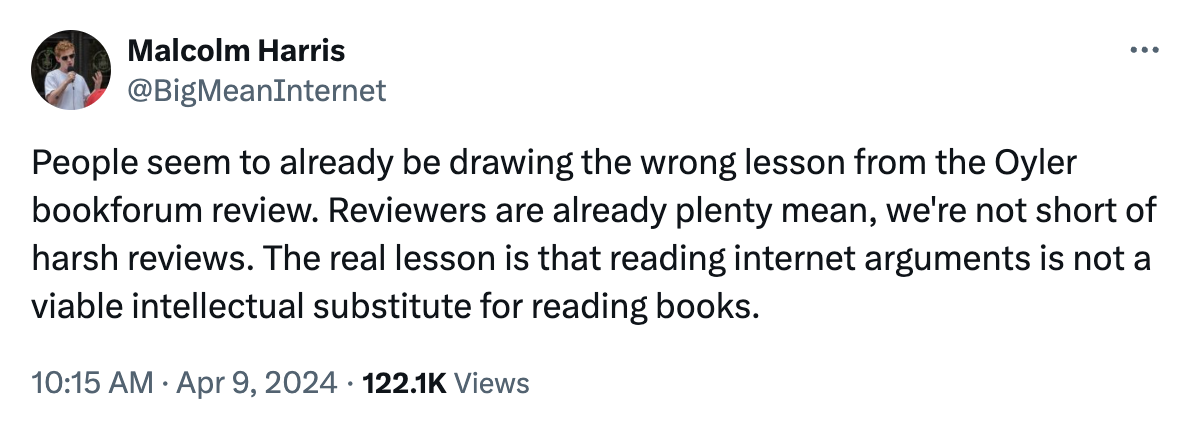
In the case of Oyler, there’s a certain “live by the sword, die by the sword” poetic justice at play (“the woman’er has become the woman’d”). An author famous for slicing up other writers’ work finds her own shredded by critic Ann Manov, who deems it “airless, involuted exercises in typing by a person who’s spent too much time thinking about petty infighting and too little time thinking about anything else.” The Mortal Kombat of book reviews. But, as Malcom Harris put it:
Over in techtopia, Brownlee’s brutal but meticulous teardown of Humane’s AI pin provoked a different kind of backlash. Many accused Brownlee of prematurely burying a scrappy startup that deserves more runway to iterate and improve. Some went so far as to call it “distasteful, almost unethical” and called for the regulation of reviewers like Brownlee. On the other end, some pointed out that Brownlee built a platform on honesty, and perhaps the AI pin isn’t for the audience of these reviews.
What unites these two tempests is the ever-fraught relationship between creators and their critics in an increasingly polarized, take-driven online milieu. Honest, substantive critique still matters—it’s how genres and scenes evolve, how creators sharpen their craft. And expertise and discernment will be even more essential as we navigate an exponentially expanding sea of AI-generated content.
But that critique is now inextricable from the relentless churn of personal brands and platform incentives. The line between good-faith criticism and performative takedown-ism gets blurrier by the day. It’s enough to make any writer or designer feel skittish about putting new work out there. Or to make critics pull their punches, for fear of running afoul of some impassioned online faction.
Despite the backlash against brutally honest reviews, the role of the critic is essential. Good criticism, delivered with substantive arguments, sharpens the overall discourse and challenges creators to do better. In an age of online “hot takes,” it’s understandable to be wary of gratuitous harshness and cheap dunks. But thoughtful, surgical critiques like these serve an important function. They remind us what’s at stake in the work we put out into the world.
Links
More on Humane: Raihan shared thoughts on “humane, tech worship, vcs, & capital as art” in the form of a Google Doc screenshot via Twitter and as Choire says, “any time a google doc gets posted on here i'm so in.”
If you read one thing, let it be this incredible piece on the horrifying, hilarious, and deeply, deeply bizarre world of SHEIN by Nicole Lipman for N+1.
Kyle Chayka covers Byung-Chul Han, “the internet’s new favorite philosopher”
Raymond Carver’s original draft of “Beginners,” with Gordon Lish’s edits. (via)
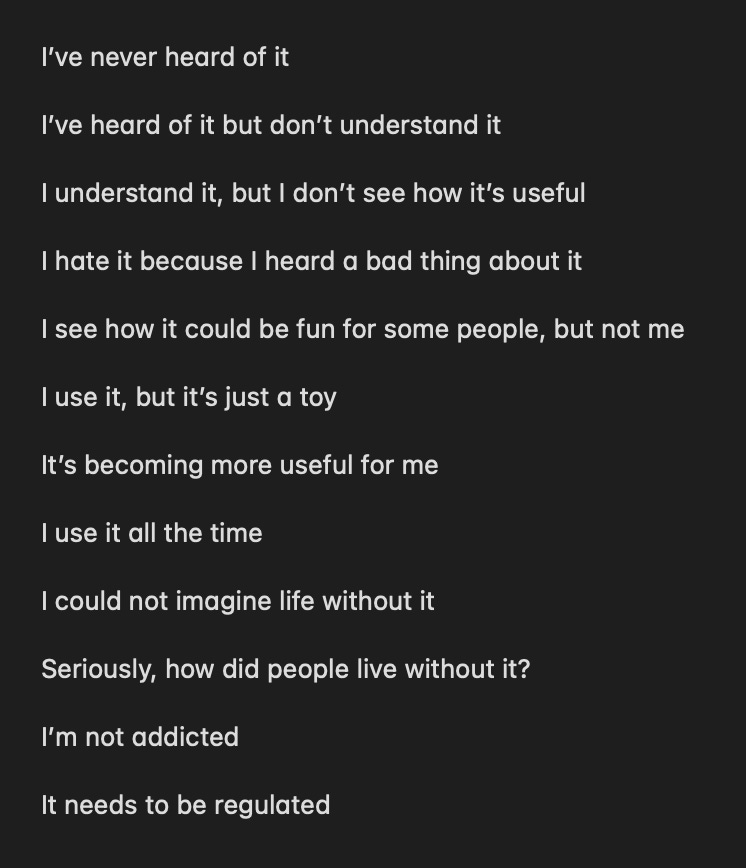
Willem VanLancker on how people commonly respond to new inventions—a progression:
We’re running out of data to feed our AI overlords. Ed Zitron says we’re headed for bubble trouble.
Art schools wade into the world of AI: RISD hosts a symposium, Ringling creates an AI Task Force.
Joan Didion would have loved this Reformation ad.
Rachel Karten’s Brand Social Trend Report: Q1 2024 is out. She breaks down five trends on Twitter.
Amazon created a fake Japanese streetwear brand to run spy ops on rivals. (via)
Jess Rosenberg and Liz Meyer launched Ladies Who Create, a podcast where they interview women in creative fields.
Caffè RIMOWA x La Marzocco. Someone get me a cup/saucer sets.
Tao Lin buried 2–3 pounds of cheese and no one knows why.
Are.na Spring Cleaning is happening this weekend.
Developh, a community of practice towards softer & critical technologies in the Philippines, is hosting a series of talks. They look great.
AI is learning our worst tropes, like using the word ‘delve’ when we want to sound smart.
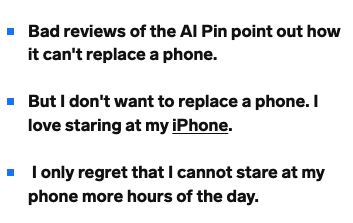
“I only regret that I cannot stare at my phone more hours of the day.” (Katie Notopoulos, via Choire.)
Reply back to this email and let me know what you think. Actually, respond anyway—even with just a “hi”—to make sure this doesn’t end up in your spam. (Tragic!)
—Carly
Word! Nice quick take. I think the same dynamic has been infecting political discourse, activism, and so on.